Open a typical list of the best SaaS directories, scroll to entry 60, and click. There’s a fair chance you land on a submit form that 404s, a parked domain, or a “premium listing” checkout. Those lists are sorted by Domain Rating, padded to a hundred entries, and, judging by entry 60, rarely rechecked.
You don’t need a hundred. You need a short list of places where buyers, early adopters, or other founders actually look, and what each costs and expects.
So here are 21. For each, we checked in October 2026 that a working submission path exists, then noted who it suits, how listing works, what to prepare, and when to skip it. No DR or traffic numbers: they change monthly and say nothing about whether your buyers browse the site. New to the channel? Start with how to plan, submit, and verify a directory campaign, then come back here to shop.
How we built the shortlist (and what we left out on purpose)
Four checks decided who got in:
- A live submission path. The submit, listing, or claim page loaded in October 2026, or the platform’s help pages described the current process.
- A recognizable audience. Software buyers, people replacing a tool, early adopters, developers, or investors.
- A listing model we could read on the platform itself. Where a platform doesn’t state a price, we say so instead of copying one from an old roundup.
- A reason to pick it over a lookalike. If two directories do the same job for the same audience, only the stronger one stays.
What the list won’t promise you
The order is a grouping, not a ranking, and nothing here promises traffic, approval, or a link type. Where a platform publishes its link policy, we mention it; otherwise, check a recent live listing’s source before counting the link.
Do SaaS directories still help SEO in 2026? They can help a new site get discovered and earn relevant mentions. But Google’s spam policies (last updated August 2026) name “low-quality directory or bookmark site links” as an example of link spam, so volume is not a strategy. Many listing links are nofollow, ugc, or redirected. The best SaaS directories earn their place through audience and credibility; link value is a side effect you verify later through referral visits and branded search. If links are the main goal, a stage-by-stage backlink system will serve you better.
When you track results, keep four states apart: submitted (you sent the form), live (the listing is public), indexed (search engines show the listing page), and link observed (you checked the link and its attributes yourself). A tracker where every row says “submitted” is a list of hopes.
The best SaaS directories at a glance
All 21 in one view. Listing models are as of October 2026 and change often, so confirm on each platform before you pay for anything.
| Directory | Type | Listing model (Oct 2026) | Best fit |
|---|---|---|---|
| G2 | Review marketplace | Free profile, paid upgrades | B2B software with paying customers |
| Capterra network | Review marketplaces | Listing request, paid lead programs | SMB software with a public offer |
| TrustRadius | Review marketplace | Free product profile, paid programs | Business and enterprise software |
| SoftwareSuggest | Software marketplace | Free listing, paid promotion | SMB tools with a company email |
| SourceForge | Software directory | Basic listing, paid placement | Business and open-source software |
| SaaSHub | Alternatives directory | Free, editorial review | Released SaaS with clear competitors |
| AlternativeTo | Alternatives directory | Free backlog, paid priority review | Apps that replace a known product |
| OpenAlternative | Niche alternatives | Free queue, paid packages skip it | Open-source projects |
| Crunchbase | Company database | Free profile | Startups talking to investors |
| Indie Hackers Products | Founder database | Account-based listing | Bootstrapped products sharing progress |
| Product Hunt | Launch platform | Free to post, editorial featuring | Polished launches with a community |
| BetaList | Early-stage launch | Paid only, refund if not selected | Pre-launch and newly launched startups |
| Uneed | Launch platform | Free line, paid fast-track | Indie SaaS that can rally votes |
| Peerlist Launchpad | Weekly launch | Verified profile, check the form | Makers active on Peerlist |
| DevHunt | Developer tool launch | Free listing, paid launch week | Developer tools only |
| Microlaunch | Launch platform | Paid plans, 30-day window | Founders who want a longer showcase |
| Fazier | Daily launch | Free with backlink, paid tiers | Small SaaS and side projects |
| TinyLaunch | Launch platform | Free queue, paid skip | Indie products open to a badge |
| Launching Next | Startup directory | Free, paid speed-up | Early startups wanting a quick listing |
| Show HN | Community launch | Free, strict rules | Technical products people can try |
| Futurepedia | AI directory | Editorial only (Nov 2026) | AI tools editors would pick on merit |
For filters across a much larger set, use the SubmitMatic directory database. What follows is the opinionated part.
Buyer review marketplaces: where software shoppers build a shortlist
Nobody browses these for fun. Buyers arrive with a problem and a budget, compare a few options, and read reviews. Complete profiles, accurate categories, and genuine reviews win here, slowly, once you have customers who’ll vouch for you.
1. G2
The heavyweight. In January 2026, G2 announced an agreement to acquire Capterra, Software Advice, and GetApp from Gartner, so it now sits behind most of the big review sites. It mainly lists B2B products with real users, and alpha or beta products are typically turned away.
Listing model: Check whether your product already exists, then request a listing; G2’s research team verifies the product before placing it in a category. G2’s guide to the free profile lists caps on the free tier, such as six screenshots and up to five pricing plans, and says pricing and free-trial buttons need an upgraded profile. Grid placement requires at least 10 reviews.
Prepare: Docs that prove you meet the category definition, customers willing to review, and current screenshots.
Skip it if: nobody is ready to review you. An empty profile is a storefront with the lights off.
2. Capterra, GetApp, and Software Advice
Three buyer-facing comparison sites, one owner: G2. As of October 2026, Capterra’s vendor page says “powered by G2 Digital Markets,” and its Get Your Product Listed button opens G2’s product request form, so expect intake to keep shifting while the networks merge. The fit is SMB software with a clear, public offer.
Listing model: The sites are free for buyers because vendors pay for traffic and leads. Capterra’s listing guidelines rule out products whose only call to action is joining a waitlist. Beta products can qualify with a working website, a public offer, and at least one review in their first calendar year. The product must be listed under its own name, on a site you control.
Prepare: A pricing or signup page that works today, plus a plan for the first review.
Skip it if: the only button on your homepage says “Join the waitlist.”
3. TrustRadius
The long-form review site, with B2B categories from AI governance and data engineering to contact center and HR software. It suits business and enterprise products whose buyers want detailed peer feedback before a demo.
Listing model: A free product profile through the vendor site’s claim-your-profile page, plus paid programs built around buyer intent data and leads.
Prepare: A named profile owner and customers who will write reviews longer than a sentence.
Skip it if: you sell a self-serve tool to individuals. The depth here is built for business buyers.
4. SoftwareSuggest
A software marketplace whose vendor signup button reads, helpfully, “List Your Product - It’s Free.” A sensible extra comparison-site presence for SMB tools, with no contract.
Listing model: The basic listing is free; paid options include pay-per-click, leads, and premium placement. The signup form rejects consumer email addresses such as Gmail and Outlook, and asks for employee and customer counts.
Prepare: An email on your product’s domain and honest answers to the company-size questions.
Skip it if: you still run everything from Gmail. Fix that first; several entries here want a domain email.
5. SourceForge
Best known for open-source hosting, SourceForge also runs a business software directory with comparison and alternatives pages. It fits business software that wants a spot in those comparisons, and open-source projects already there.
Listing model: The vendor page has an Add a Product route and mentions basic listings without spelling out their cost. Upgraded listings buy placement in categories, comparisons, and alternatives pages, and the page states plainly that your exact position depends on the price of your plan.
Prepare: Realistic expectations. A basic listing here is presence, not promotion.
Skip it if: you hoped a free listing would rank you in comparisons. Position is for sale, and SourceForge says so.
Alternatives directories: catching buyers mid-breakup
Alternatives sites catch a great moment in software buying: someone is fed up with their current tool and searches for ”[competitor] alternatives.” Your listing has to make the swap believable, so name the right competitors and describe your job in the words a frustrated user would use.
6. SaaSHub
A discovery and alternatives site that calls itself a free tool for promoting your product. For a released SaaS with obvious competitors, it’s one of the easiest yeses here.
Listing model: Free submission with an approval process. Its submission page says unreleased products are rejected immediately, and it doesn’t accept waitlist pages, free subdomains, non-English products, or agencies. Listing competitors is effectively required: without them, the submission goes to the bottom of the queue. Verifying with an email on your product’s domain gives you higher priority. Paid promotion options sit on top.
Prepare: Three to five honest competitors, a few accurate categories, and a domain email.
Skip it if: you haven’t shipped. “Rejected immediately” means what it says.
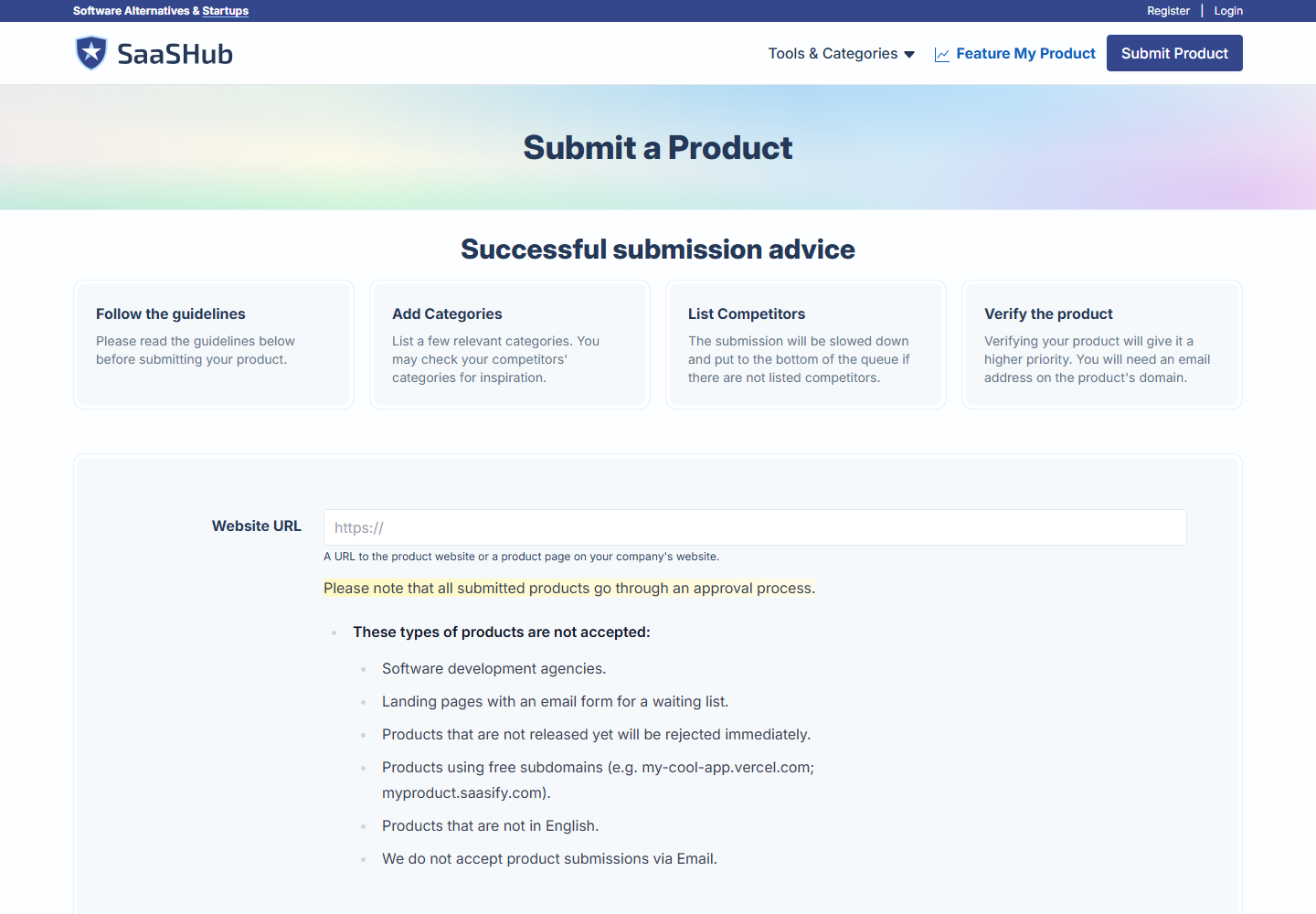
SaaSHub’s own submission page doubles as a preparation checklist: released product, real competitors, accurate categories. Screenshot captured September 12, 2026 (UTC).
7. AlternativeTo
A crowd-curated site built around one question: what can replace this app? It suits apps that substitute for a well-known product and are available broadly, not just in one city or country.
Listing model: Standard submissions are free but go into a review backlog, and the AlternativeTo FAQ is blunt that most apps in it won’t be looked at for a very long time. A one-time paid priority review usually gets a decision within one to two business days, and the FAQ stresses that paying moves you up the queue but doesn’t buy approval. Unreleased apps, closed betas, and early access products are excluded, and personal sites, single-purpose online tools, AI wrappers, and clones are typically declined.
Prepare: A verified email, an English-language product, and a description with no links or contact details; URLs go in their own fields.
Skip it if: you’ve built a thin AI wrapper or a single-purpose web tool. Paying for review won’t change the answer.
8. OpenAlternative
A directory of open-source alternatives to proprietary software. The entry requirement is non-negotiable: a real open-source license and repository.
Listing model: As of November 2026, the submit page says free listings go live one per weekday, so the wait can be a few months, and a paid package skips the queue and publishes within 24 hours. In October 2026 the package page reserved the dofollow link for its higher tiers. Check the current packages before you decide whether waiting is acceptable.
Prepare: Your license, repository link, and the proprietary product you replace.
Skip it if: you’re closed source. No package changes that.
The next two aren’t buyer sites. They’re the profiles people check when they want to know whether you’re real.
9. Crunchbase
A company database used by investors, partners, journalists, and sales teams. It’s a credibility listing, not a source of software buyers.
Listing model: Any registered user who has authenticated through a social account can create a company profile. Claiming an existing profile requires an email on the company’s domain.
Prepare: Founding date, headquarters, founders, a one-paragraph description, and funding details only if they’re public.
Skip it if: you aren’t raising, hiring, or pursuing partnerships. Then it can wait.
10. Indie Hackers Products
A products database inside the Indie Hackers founder community, sortable by verified revenue, for bootstrapped founders comfortable sharing numbers and progress in public.
Listing model: You add a product from your account via the Add Your Product button. The value comes from taking part in the community; a silent listing does little.
Prepare: A short origin story and a willingness to post updates.
Skip it if: you’d rather not talk revenue in public. A listing with no updates is a nameplate on an empty desk.
Launch platforms: worth a slot when you can show up on the day
Launch platforms reward timing and engagement. A listing sits on a leaderboard for a day or a week, then becomes an archive page, and signups depend on someone answering comments and fixing issues while the window is open. Space launches out. Our roundup of startup launch platforms goes deeper on scheduling.
11. Product Hunt
The best-known general launch platform, with daily leaderboards and a Product of the Day spot. It rewards polished, easy-to-try products backed by someone willing to spend launch day in the comments.
Listing model: Product Hunt’s launch page says it’s 100% free to use. You need a personal account (company accounts can’t post), and launches go live at 12:01 AM Pacific. Being featured is an editorial decision: the featuring guidelines, updated March 10, 2026, look for products that are useful, novel, high craft, or creative, and exclude waitlisted products without immediate access, directories, templates, boilerplates, services, courses, and deal sites.
Prepare: A thumbnail, at least two gallery images, a description of up to 260 characters, a maker comment, and a working first-run experience. Our Product Hunt launch playbook covers each asset.
Skip it if: you’re launching a service, a template, or a waitlist. Those are excluded from featuring, which is where the attention is.
12. BetaList
A curated showcase for pre-launch and recently launched startups with a clear value proposition, a decent design, and their own domain. Free hosting subdomains and direct app store links aren’t accepted.
Listing model: Paid only. The BetaList FAQ says there’s no free submission option anymore, current prices appear at the end of the submission form, and you get an automatic full refund if your startup isn’t selected. BetaList also says its Visit Site button is not nofollow and passes through a 301 redirect that adds a ref=betalist tag.
Prepare: A landing page that explains the product in one screen.
Skip it if: you launched months ago. BetaList is for the before-and-just-after moment.
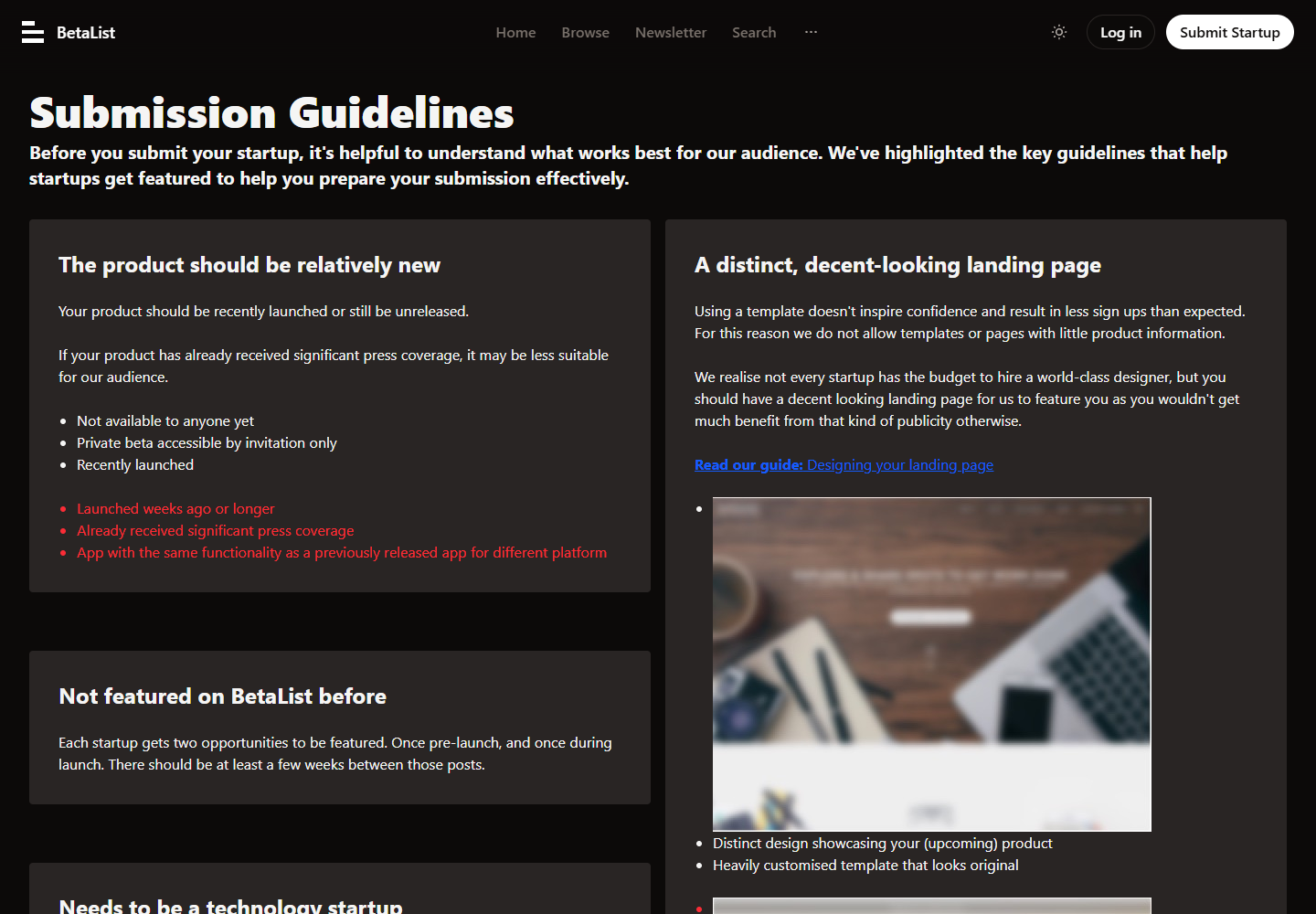
BetaList’s criteria page shows what its editors select for; pair it with the FAQ, which now states that every submission is paid. Screenshot captured September 12, 2026 (UTC).
13. Uneed
A launch platform for indie products, ranked by launch-day upvotes, for founders who can bring a few supporters on the day.
Listing model: According to the Uneed pricing page as of November 2026, joining the free line gets you a launch date at least 50 days out, and you need an upvote score of 10 to stay published and 20 to earn the dofollow link. A Fast-track option ($19.99) gets a slot in about 14 days, and Skip the line ($39.99) lets you pick the date with the dofollow link guaranteed.
Prepare: A launch date you can actually work, and a short message for people who already know your product.
Skip it if: nobody will turn up for you. Under a score of 10, the listing comes down.
14. Peerlist Launchpad
A weekly launch program (formerly Spotlight) inside Peerlist, a professional network for builders. It works best for makers who already have a network there.
Listing model: The launch window opens every Monday. Peerlist’s help center says the project must be 100% complete and the maker needs a verified profile; winners get a badge and are featured in the newsletter and on social channels. Pricing isn’t stated on the official help pages, so check the submission form before assuming it’s free.
Prepare: A verified profile, a finished project page, and time to engage during launch week.
Skip it if: you’d be creating your Peerlist account the morning of launch.
15. DevHunt
An open-source launch platform for developer tools, with a new batch each week. Strictly developer tools: APIs, SDKs, CLIs, frameworks, monitoring, testing, auth, and similar.
Listing model: As of October 2026, its FAQ says a basic listing is free and gives every tool a permanent page with a nofollow link, while a low-cost paid launch lets you choose the launch week, adds a newsletter spot, and makes the link dofollow. A boosted tier adds placement and a post on X.
Prepare: A README-quality description and something a developer can try in minutes.
Skip it if: your users don’t write code. Non-developer tools aren’t accepted.
Longer windows, badge trades, and one wildcard
The next five bend the format: a month-long window, two link-for-listing trades, a form with no leaderboard, and one entry that isn’t a directory at all.
16. Microlaunch
A launch platform built around a 30-day visibility window instead of a single day, for founders who’d rather run a slow showcase than a one-day vote race.
Listing model: As of October 2026, the premium page lists two paid plans, Launch Pro and Launch Plus. A free route isn’t clearly described there, so confirm it in the submission flow.
Prepare: A plan for the whole month, not just the first day.
Skip it if: you only do free listings. Assume you’re paying until the flow shows otherwise.
17. Fazier
A daily launch platform with weekly and monthly leaderboards, suited to small SaaS products and side projects.
Listing model: As of October 2026, the free tier promises review and listing within 30 days but requires a backlink to Fazier on your homepage or footer. Paid tiers drop the backlink requirement and let you publish immediately or schedule a date.
Prepare: A decision about the reciprocal link before you submit, not after.
Skip it if: your rule is “no footer badges” and you won’t pay.
18. TinyLaunch
A launch platform with a homepage competition and a premium placement slot, for indie products willing to put a launch badge on their site.
Listing model: As of October 2026, the free Standard launch puts you in a queue, and the top three launches receive badges and a backlink. The site says the dofollow backlink is granted when you embed the badge with a dofollow link to TinyLaunch. A paid Premium launch skips the queue and guarantees the backlink.
Prepare: The same reciprocal-link decision as Fazier, and a launch-day nudge for your audience.
Skip it if: the badge rule ruled out Fazier. Decide for the pair once.
19. Launching Next
A startup directory that reviews submissions every day. No leaderboard, no vote race: you fill in a form and wait for an email.
Listing model: The submit page says submitting is free, and you receive an email if your startup is published. A paid upgrade offered after the form asks for consideration within one business day.
Prepare: A 5-to-8-word headline, a description of up to 2,500 characters, and 5 to 10 tags. The form also asks for your planned 90-day marketing spend, so have a number ready.
Skip it if: you’re truly out of hours. It’s among the cheapest entries here, in money and effort.
20. Show HN
Not a directory, but the Hacker News format for sharing something you built, and a source of blunt early feedback for technical founders. It works for technical products people can try right away, ideally without a signup.
Listing model: Free, with strict rules. Show HN is for something other people can play with; landing pages, signup pages, newsletters, and lists are off topic, and asking friends to upvote or comment is explicitly discouraged. The title must begin with “Show HN.”
Prepare: A demo that works without email capture, and time for pointed questions.
Skip it if: all you have is a landing page. That’s off topic on arrival.
Niche directories: when a specialist list beats a big one
A small directory your exact buyers browse can beat a large general one. AI tools, developer tools, open source, and vertical software all have their own lists; the trick is telling a living one from an abandoned one.
21. Futurepedia
A large, editorially curated AI tools directory with a newsletter, and proof of how fast listing rules move. It suits established AI products with a clear use case that editors would pick on their own.
Listing model: No self-serve route as of November 2026. In October, its enhanced-listing page sold a one-time verified listing with a newsletter feature and a click guarantee. By November 18, 2026, that page returned a 404, the site showed no submission link, and its editorial guidelines said it reviews “only the tools that make a meaningful impact in real workflows.” For AI directories that still accept submissions, see our list of AI directories.
Prepare: A clear category, a public demo, and a privacy policy, so the product holds up if editors find it.
Skip it if: you planned to submit this week. You can’t.
How to vet a niche directory in five minutes
Before a niche list goes into your plan, check its pulse:
- Recent listings from the last few weeks. If the newest is from last spring, nobody’s home.
- A working submit page, not an erroring form or a parked domain.
- Category fit: a few listed products your buyers would also consider.
- Visible moderation: rules, rejections, or editorial notes. Accept-everything directories aren’t selling an audience.
- A reachable owner whose contact address answers.
How to choose your first ten SaaS directories
Twenty-one is too many for one month. For this hands-on layer, around 7 to 12 in the first 90 days is manageable for a solo founder, because launches and review marketplaces need prep and follow-up. The long tail of smaller directories is a separate call: some founders add dozens for consistent brand citations, others skip them. Either way, a count with no record of what went live tells you nothing.
Narrow the list in this order:
- Write your stage in one line. “Pre-launch with a waitlist,” “launched, no customers,” or “paying customers, under 20 reviews.” AlternativeTo and SaaSHub reject unreleased products, and Capterra won’t list a waitlist-only page. Still behind a waitlist? BetaList (paid) and a strong landing page are your realistic options.
- Pick two or three always-on profiles. Which SaaS directories are worth it for a brand-new product? The ones that accept launched but unproven products and reward accurate information over reviews: usually SaaSHub and AlternativeTo, plus Crunchbase if you talk to investors.
- Add review marketplaces only when you can feed them. A zero-review profile does little for a buyer comparing options, so wait until five happy customers will review.
- Choose at most two launch platforms per month. DevHunt for developer tools, Product Hunt for polished general products, Uneed or TinyLaunch for indie SaaS.
- Set rules for paid and reciprocal options up front, such as “one fast-track per quarter, at most one footer badge.” Impulse buys happen at checkout.
- Write one master description and adapt it per field.
- Track every entry by state. A plain spreadsheet works; our guide to tracking directory submissions shows the columns worth keeping.
Paying for speed is fine. Paying blind is not.
Are paid SaaS directories worth the money? Sometimes, when you know what you’re buying: a fast-track through a free queue (Uneed, AlternativeTo), a guaranteed link or placement (TinyLaunch, Fazier), or an editorial showcase with a refund if you’re not selected (BetaList).
Write down the outcome you expect, such as “a launch date within two weeks,” then compare it with what you got. Be wary of anything sold only as “SEO value,” the claim you can verify least. Our comparison of paid vs free SaaS directories goes further.
Approval clocks run from instant to “a very long time”
How long do SaaS directory approvals take? Anywhere from instant to months. Some launch platforms assign a date when you join a free line, and Uneed’s is at least 50 days out. AlternativeTo’s FAQ says its free backlog can take a very long time, and sells a priority review instead.
So submit always-on profiles early, calendar launch dates the day you get them, and check pending submissions every couple of weeks rather than waiting for emails that may never arrive.
Worked example: a hypothetical invoicing tool picks five
Say you run an invoicing tool for freelance designers: launched two months ago, free and paid plans, about 40 paying users, no reviews.
Profiles first. SaaSHub gets five honest competitors and a domain-email verification for priority. On AlternativeTo, you list it as an alternative to the two tools your users most often mention leaving, and skip the paid review because nothing depends on the date.
One launch, chosen for fit. DevHunt is out. You want practice before Product Hunt, so the first launch is Uneed on a free-line date, with a note to existing users asking for feedback, not votes.
Review marketplaces later. G2 and the Capterra request wait until month three, when five paying users have agreed to write reviews and the pricing page is current.
What you skip. BetaList (past early access), Futurepedia (not an AI tool), and OpenAlternative (not open source).
The result: five targets in 90 days, each with a written reason. If one starts sending trial signups, you know which kind of directory to expand next, which sixty unexplained submissions never tell you.
Rule of thumb: The best SaaS directory for you is the one where your next customer is already browsing. Pick for fit and stage first. Count links last.
Next steps: turn the best SaaS directories into your shortlist
The 21 above are the high-judgment layer, where your own voice matters. In one sitting:
- Pick your stage line and strike every entry that rejects products at your stage.
- Choose up to ten targets, each with a one-sentence reason. The curated SaaS directory list helps you swap in alternatives for your category.
- Write your paid-option rules at the top of your tracker, next to a short and a long version of your listing copy.
- Book the first two submissions for this week.
Beyond this list sits a long tail of smaller directories that mostly need accurate, consistent data entry, which is where founders lose whole weekends. SubmitMatic is a done-for-you SaaS directory submission service for that part: you fill in your details once, and we pick directories by fit, handle signups through a dedicated inbox, adapt your description per site, and track every submission, with human review. The one-time packages cover 60+, 100+, or 140+ submissions ($60, $100, or $140, taxes not included), with a 48-hour turnaround and a Google Sheet report with verification screenshots. You own the listings. Each directory still reviews on its own timeline, nothing is guaranteed, and launch days still need you. The founder’s note explains why SubmitMatic exists.
Even the best SaaS directories become a channel only once your listings are live and you can see what they send.